MIRA Lab, Metacognitive Instructional Regulation Agents
Epistemic Ownership
in AI‑Assisted Learning
MIRA Lab studies whether students can explain, defend, and revise the work they produce with AI. We build learning platforms that record this reasoning and deploy them in credit-bearing courses at the University of North Texas.

From the director
I study how students keep ownership of their reasoning when AI can produce the work for them. I design and build the lab's platforms myself, and I run them in UNT courses so the evidence comes from real coursework.
Ji Hyun Yu, Ph.D.
Assistant Professor of Learning Technologies, University of North Texas
- Editorial board, Educational Technology & Society and Interdisciplinary Journal of Problem-Based Learning
- Facilitator, AMIS Community of Research
- Lead, AI + Learning Analytics concentration, LTEC M.S.
- Affiliated faculty, Data Science
Research platforms
Designed and built in the lab, and deployed in credit-bearing courses under IRB approval.

MIRA-Agent
Asks students to explain their reasoning, and any pasted code, before their code can run.
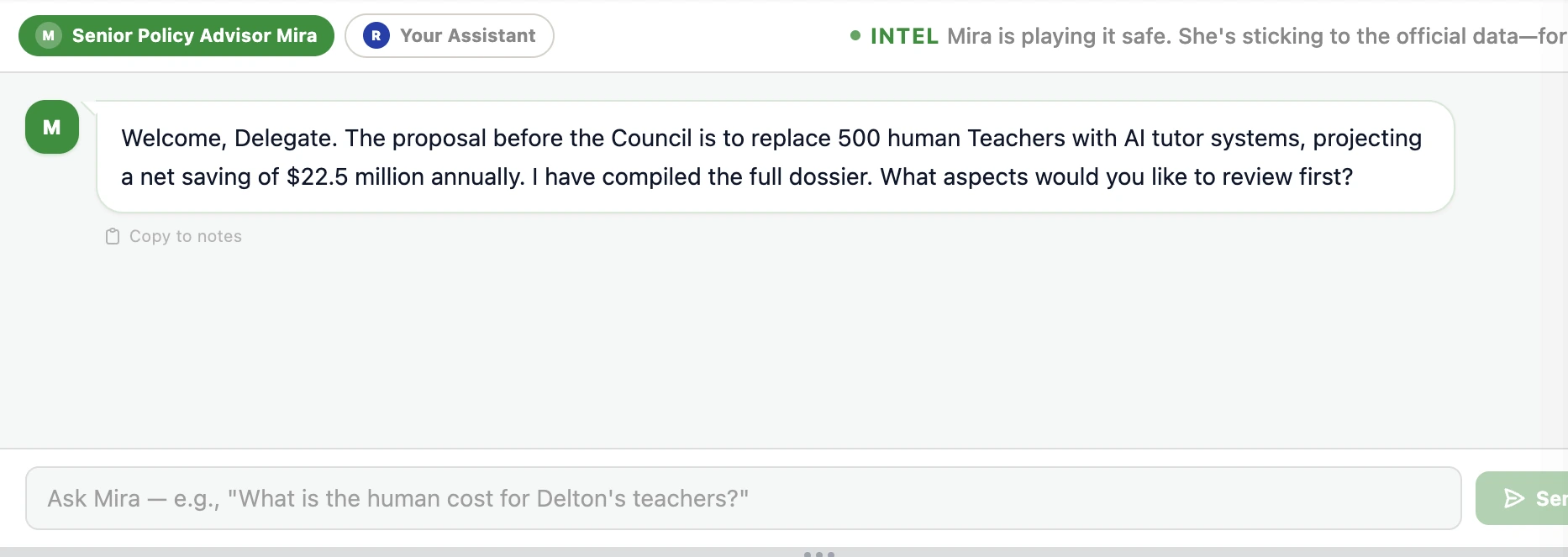
MIRA-Sim
AI stakeholders press students toward their positions across six policy stages.
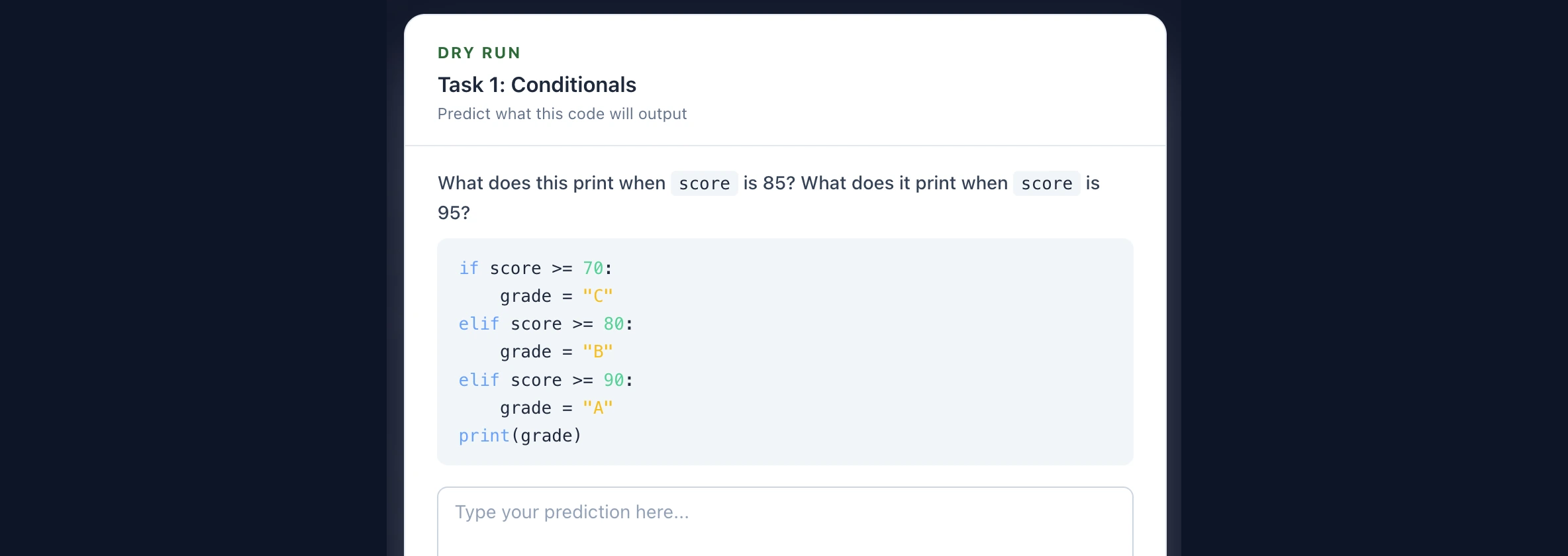
MIRA-Py
Each Python task opens only after a concept check and a code check.
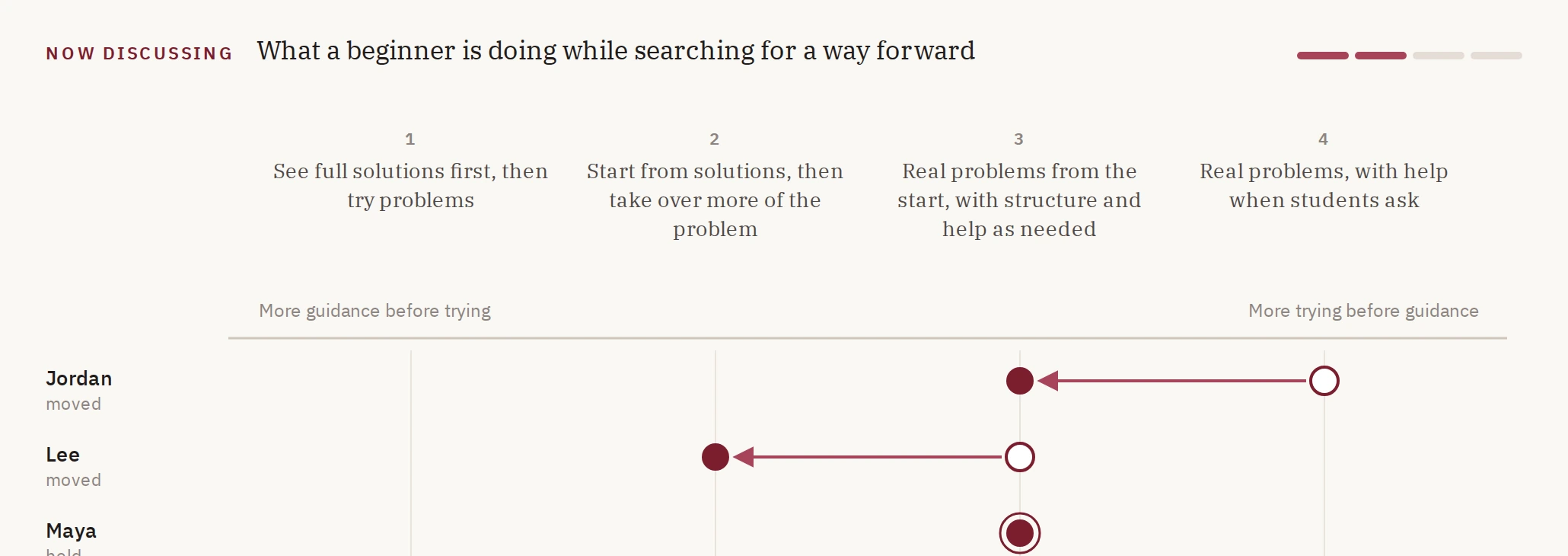 Design mockup
MIRA-Roundtable
Small groups meet live to debate a question without a settled answer while an AI discussant argues the side no one has taken.
Epistemic ownership
Epistemic ownership is a learner's capacity to explain, defend, and revise work they submit as their own.
More detailsProductive friction
Productive friction is effort that a learning environment deliberately keeps with the learner because that effort produces learning.
More detailsEpistemic labor redistribution
Epistemic labor redistribution is the shift of cognitive work between a learner and an AI system during a task.
More detailsThe fluency trap
The fluency trap is the combination of low epistemic ownership with high confidence in that ownership.
More detailsRecent publications
- Why educators use but do not endorse artificial intelligence in higher education
Yu, J. H., Romero, P.*, Dunlap, M.*, & Warren, S. Innovative Higher Education, accepted
- Measuring cognitive presence in online discussions: Automated detection and instructional insights from a MOOC context
Yu, J. H., Tu, F.*, Chen, H., Ding, J., Hsieh, C-J.*, Dong, L.*, Kim, H., & Watson, S. L. Educational Technology Research and Development, accepted
- Verification without criteria: An Epistemic Network Analysis of metacognitive laziness in Generative AI research
Yu, J. H., Tu, F., Cheng, L., Li, S., & Zheng, Z. Online Learning Journal, accepted
News
Publication, Sep 2026
Article accepted in Innovative Higher Education
Publication, Sep 2026
Cognitive presence detection article published in Educational Technology Research and Development
Grant, Sep 2026
IMLS Laura Bush 21st Century Librarian Program award for SALAMANDER
Talk, Jul 2026
MIRA-Sim findings presented at the HAI-Agency Workshop, AIED 2026, Seoul